What's actually proposed
Gustin Solar grew out of a smaller project called Sapling Solar, begun by developer Ranger Power and transferred to Consumers Energy — one of eight “Active Solar Projects” on the utility's solar projects page when we viewed it on Oct 2, 2026 (captured page), in its statewide build-out toward roughly 8,000 MW of solar by 2040.
The whole project announced Sept 2025
- Nameplate capacity335 MWac (241 + 94, per the two site plans)
- TownshipsGustin + Harrisville
- Fenced area~1,800 acres (Consumers, Gustin PC minutes, June 2, 2026); site plans: 1,266.9 + 479.7 = 1,746.6 ac
- Homes, Consumers Energy’s estimate“enough to power about 60,000 homes” (news release, Sept 26, 2025)
- Construction start (expected)“Fall 2026” (Harrisville cover letter, p. 1); “fourth quarter (Q4) of 2026” (Harrisville application summary, PDF p. 5; Gustin application, p. 1208)
- In-service date (expected)“June 2027” (Harrisville cover letter, p. 1); “December 31, 2028” (Harrisville application summary, PDF p. 5; Gustin application, p. 1208); the filings differ
Gustin Twp. share per the May 15, 2026 application
- CapacitySite plan: 241 MWac / 299 MWdc. Application: 241 MWac (p. 237); 240 MWac where it combines the 215 MW approval and the 25 MW addition (p. 1208)
- Approved Dec 2, 2024 (Sapling Solar)215 MWac
- Denied Aug 6, 202625 MWac addition
- Total property area (Consumers' property boundary in Gustin Twp.)3,985.6 ac
- Property area used for solar facilities2,684.2 ac
- Area within limits of disturbance1,371.0 ac
- Area within project fencelines1,266.9 ac
- Area developed (earth-disturbing activity)138.4 ac
- Tree clearing35.1 ac
Source: application, site plan sheet CV-200-001 (p. 99); capacity also pp. 237, 1207–08.
Harrisville Twp. share per the June 2026 filing
- Fenced project area479.7 ac (site plan, Exhibit B p. 1) · 523 ac (decommissioning plan, Exhibit G p. 7); the two filings differ
- Solar modules165,321
- Capacity116.5 MWdc / 94 MWac
- Participating parcels10 (~1,015 ac. eased)
- Perimeter fence12.8 miles
- New gravel roads5.8 miles
- Above-grade cable~335 miles
- Operating term30 years
How big is it? Equal-area squares, not the project’s shape
How to read this: each square has the same area as what it stands for, all at one scale. They are not the real shapes: we have no mapped boundaries, so each township is drawn as a square of equal area, and the project’s areas sit in a corner. Filled and outlined squares in the same place are figures from different records.
Fenced area in each township. Consumers Energy's site plan and decommissioning plan for each township give different figures; both are drawn.
Whole project: no figure in this measure.
The fenced area in Gustin Township, 1,266.9 acres per the site plan, is 1.98 square miles, 5.5% of the township's land area. Per the decommissioning plan it is 1,261 acres, 1.97 square miles. The fenced area in Harrisville Township, 479.7 acres per the site plan, is 0.75 square miles, 2.5% of the township's land area. Per the decommissioning plan it is 523 acres, 0.82 square miles.
Every area and its source
| Area | Acres | Square miles | Share of township land | Record and its words |
|---|---|---|---|---|
| Fenced area, by township | ||||
| Area within project fencelines, Gustin Township | 1,266.9 acres | 1.98 | 5.5% | Consumers Energy, Gustin Township site plan, sheet CV-200-001, in the May 15, 2026 application, p. 99: “AREA WITHIN PROJECT FENCELINES 1,266.9 AC”. Figure from Consumers Energy. |
| Fenced site, Gustin Township decommissioning plan | 1,261 acres | 1.97 | 5.5% | Consumers Energy, Gustin Township decommissioning plan, §5.3.1, in the May 15, 2026 application, p. 239: “1,261 acres of fenced site”. Figure from Consumers Energy. |
| Area within project fencelines, Harrisville Township | 479.7 acres | 0.75 | 2.5% | Consumers Energy, Harrisville Township site plan (Exhibit B), sheet CV-200-001, p. 1: “AREA WITHIN PROJECT FENCELINES 479.7 AC”. Figure from Consumers Energy. |
| Fenced site, Harrisville Township decommissioning plan | 523 acres | 0.82 | 2.7% | Consumers Energy, Harrisville Township decommissioning plan (Exhibit G), §5.3.1, p. 7: “523 acres of fenced site”. Figure from Consumers Energy. |
| Whole project, as stated | ||||
| Project footprint, whole project | 1,800 acres | 2.81 | not applicable | Consumers Energy, Solar Energy Projects page, Gustin Solar Project (printed Oct 2, 2026), p. 2: “Gustin Solar Project … Project Footprint: 1,800 acres”. Figure from Consumers Energy. |
| Total fenced area, whole project, as recorded from Consumers Energy's presentation | 1,800 acres | 2.81 | not applicable | Gustin Township Planning Commission, minutes of the June 2, 2026 special meeting, p. 1: “Total 1800 acres total fenced In area”. Figure from Consumers Energy's presentation, as recorded in the township's minutes. |
| Fenced area, both townships, adding the two site plans | 1,746.6 acres | 2.73 | not applicable | Our addition of the two site plan figures above. |
| Fenced site, both townships, adding the two decommissioning plans | 1,784 acres | 2.79 | not applicable | Our addition of the two decommissioning plan figures above. |
| Property and easement area | ||||
| Total property area, Gustin Township (footnote: "includes the overall Consumers Energy property boundary in Gustin Township") | 3,985.6 acres | 6.23 | 17.5% | Consumers Energy, Gustin Township site plan, sheet CV-200-001, in the May 15, 2026 application, p. 99: “TOTAL PROPERTY AREA 3,985.6 AC”. Figure from Consumers Energy. |
| Property area used for solar facilities, Gustin Township | 2,684.2 acres | 4.19 | 11.8% | Consumers Energy, Gustin Township site plan, sheet CV-200-001, in the May 15, 2026 application, p. 99: “PROPERTY AREA USED FOR SOLAR FACILITIES 2,684.2 AC”. Figure from Consumers Energy. |
| Ten Harrisville Township parcels under easement | 1,015 acres (+/-) | 1.59 | 5.2% | Grobbel comment letter, July 26, 2026 (a public comment, not a Consumers Energy filing), p. 4: “The company has signed easement agreements with the landowners of ten (10) parcels within Harrisville Township, totaling 1,015 acres (+/-)”. Figure from the Grobbel comment letter. Consumers Energy's Exhibit A (landowner agreements: deeds and recorded solar easement memoranda) gives acreage tract by tract; we found no total stated there. |
| Reference areas | ||||
| Gustin Township, land area | 22,839 acres | 35.686 | not applicable | Census Bureau, 2025 Gazetteer File, county subdivisions, Michigan (GEOID 2600135740, column ALAND_SQMI): row “Gustin township”, column ALAND_SQMI: 35.686. Our conversion of the Census figure, at 640 acres per square mile. |
| Harrisville Township, land area | 19,402 acres | 30.316 | not applicable | Census Bureau, 2025 Gazetteer File, county subdivisions, Michigan (GEOID 2600136880, column ALAND_SQMI): row “Harrisville township”, column ALAND_SQMI: 30.316. Our conversion of the Census figure, at 640 acres per square mile. |
| One square mile | 640 acres | 1.00 | not applicable | Definition: there are 640 acres in a square mile. |
Sources: Consumers Energy’s site plan and decommissioning plan for each township, its Solar Energy Projects page, the Gustin Township Planning Commission’s June 2, 2026 minutes, the Grobbel comment letter, and the Census Bureau’s 2025 Gazetteer (township land area); pages and links in the table. Square sizes, sums, square miles and shares are our calculations.
Two clocks are running
The project's local review and a statewide legal challenge over who controls solar siting are unfolding at the same time — and each shapes the other.
"Sapling Solar" applies in Gustin Twp.Project
Ranger Power seeks a special land use permit for a 215 MW array on ~1,427 acres.
Townships and counties appealLegal
Townships and counties appeal the MPSC's Oct 10, 2024 order implementing the new law to the Court of Appeals.
PA 233 takes effectLegal
Michigan's 2023 siting law creates a state siting certificate from the Public Service Commission for solar projects of 50 MW or more and sets out when a developer may apply for one. Where a township has given notice of a compatible ordinance, the developer must apply to the township first (Sec. 223(3)). Where it has not, the developer may apply to the commission or to the township. Statute
Gustin Twp. approves Sapling SolarProject
The Planning Commission grants special land use approval for 215 MW on about 1,427 acres. The township's Zoning Board of Appeals grants variances for a 50 dBA sound level at the outer wall of a building and a 50-foot setback. Minutes
Harrisville Twp. adopts a new zoning ordinanceProject
The ordinance's cover reads “Adopted May 14, 2025 By Harrisville Township Board” (ordinance, p. 1). It repeals “the Zoning Ordinance #11414 previously adopted by the Township and all amendments thereto” (Art. 24) and sets rules for solar energy systems in Sec. 3.22 (PDF pp. 28–32). The township's zoning page, as captured Oct 1, 2026, lists no master plan, and the ordinance's searchable text does not mention one (zoning page).
Consumers Energy announces Gustin SolarProject
335 MW across Gustin and Harrisville Townships, absorbing Sapling Solar.
Court of Appeals rules on the MPSC's orderLegal
The court affirms the commission's October 2024 order in part and reverses it in part. It holds that the commission “incorrectly interpreted PA 233 with respect to a statutory timeline” and “improperly expanded the statutory definition of an affected local unit,” a definition the body of the opinion calls “more limited” than the statute's, and that it “properly interpreted the term CREO.” Opinion
Special Land Use application filedProject
Site plan plus glare, sound, decommissioning, and emergency-response exhibits land at Harrisville Township — alongside a developer letter arguing state law preempts local groundwater regulation.
Appeal to the Michigan Supreme CourtLegal
The townships and counties apply for leave to appeal the Court of Appeals decision. On July 16 the docket lists two cross-appeals and a motion to expedite, and the court's caption now lists the commission as “Appellee/Cross-Appellant/Cross-Appellee” and four intervening organizations as “Intervenor Appellees/Cross-Appellants.” Several parties have asked the court to review different parts of the decision. The court has not decided whether to hear the case. Docket · Order
Gustin Twp. hearing: approval motion tabledProject
Consumers Energy asks Gustin Township to approve a 25 MW addition to the approved project. A motion to approve with conditions is made and seconded, then tabled. Minutes
The Grobbel letterProject
Grobbel Environmental & Planning Associates, in a letter to Harrisville Township that describes itself as public comment, calls the application “administratively incomplete” and says it “strongly urge[s] Harrisville Township to deny” the project as proposed (pp. 1, 3, 17). Letter
Gustin Twp. denies the 25 MW additionProject
At the Sunrise Center in Lincoln, the Planning Commission votes 5–0 to rescind the tabled motion to approve, then 5–0 to deny the application, which its minutes describe as an “Addition to previous permit.” The motion's stated reason: “the record does not show that the application meets the required Gustin Township Zoning Ordinance standards, because it does not show that the use fits the area and will not harm nearby people and land.” The 2024 approval of 215 MW is not addressed. Minutes posted Sept 7; not yet marked approved. Minutes
Supreme Court accepts friend-of-the-court briefsLegal
An order in case No. 170249 allows briefs from the Michigan Farm Bureau and a group of solar developers. The court has not yet decided whether it will hear the appeal. Order
Harrisville Twp. Planning Commission meetsProject
Wednesday, 7 p.m., Harrisville Township Hall, per the township's published schedule. As of Oct 1 the township has posted no agenda or notice for this meeting, and no instructions for written comment. Contacts as listed on the township's website: Chairman Duane Dillard, 989-724-5265; Zoning Administrator Tony Atkinson, 989-916-7710.
How to read this: time runs along the line, to scale. Circles on one side are the project track; diamonds on the other are the statewide legal track. Markers that would overlap are stacked. Move the playhead with the slider, the Earlier and Later buttons, or the arrow keys: entries up to the playhead are filled, later ones are open, and the entry at the playhead is printed in full. The dashed line is today, Oct 1, 2026; an entry dated after it is drawn with a dashed outline because it is scheduled and has not happened. A coloured bar on the line means the page gives a month, not a day.
Source: each entry is quoted from this briefing’s timeline, and ten of the 14 entries link to a record in the records library (the text of PA 233, Harrisville Township’s zoning ordinance, three sets of township minutes, the Grobbel letter, the Court of Appeals opinion, the Michigan Supreme Court docket and order, and Harrisville Township’s published schedule); the link is shown with the entry, and the other four carry no record link on this page and rest on the source list at the end of the briefing.
A township "no" may not be final
One township has now said no to part of this project. On Aug 6, Gustin Township's Planning Commission denied a 25 MW addition; its 2024 approval of 215 MW has not been rescinded in any record we found. Harrisville Township has not yet decided on its 94 MW part. Michigan's 2023 siting law, Public Act 233, applies to solar facilities of 50 MW or more and sets out when a developer can take a project to the Michigan Public Service Commission (MPSC) instead.
Path explorer
Who decides?
Set three facts about an application and follow its route between the township hall and the Michigan Public Service Commission in Lansing, as Public Act 233 of 2023 lays it out.
- Size decides whether the law applies. Part 8 of Public Act 233 applies to a solar energy facility with a nameplate capacity of 50 megawatts or more, a wind energy facility of 100 megawatts or more, and an energy storage facility of 50 megawatts or more with an energy discharge capability of 200 megawatt hours or more. Sec. 222(1)
- The developer offers to meet. At least 60 days before its public meeting, the developer offers in writing to meet the chief elected official of each affected local unit to discuss the site plan. Sec. 223(2)
- The township says whether it has a compatible ordinance. A compatible renewable energy ordinance (CREO) is one whose requirements are no more restrictive than Sec. 226(8); a township with a moratorium in effect is considered not to have one. If, within 30 days following the meeting, the chief elected official notifies the developer that the township has a CREO, the developer files for approval with the township. Secs. 221(f), 223(3)
- With a CREO, the township hall decides first. The township approves or denies the application within 120 days after receiving it. The applicant and the township may jointly agree to extend this deadline by up to 120 days. Sec. 223(3)(b)
- If the township approves, the decision stays local. Construction must begin within 5 years after the permit is granted and any challenges are concluded. The township may extend this at the developer’s request, and shall not revoke the permit except for material noncompliance. Sec. 223(4)
- The developer may submit its application to the Michigan Public Service Commission if any of these apply:
- the township fails to approve or deny the application in time; Sec. 223(3)(c)(i)
- the application complies with the requirements of Sec. 226(8), but the township denies it; Sec. 223(3)(c)(ii)
- the township amends its zoning ordinance after giving notice of a CREO, and the amendment is more restrictive than Sec. 226(8). Sec. 223(3)(c)(iii)
- Without a CREO, the developer may apply to the commission. Before beginning construction, a developer may obtain a certificate from the commission; a local unit exercising zoning jurisdiction may also request the commission to require one. Sec. 222(2) The developer first holds a public meeting in each affected local unit, with the clerk notified at least 30 days before and notice published at least 14 days before. Sec. 223(1) It may still choose the township’s process if that process allows the facility to be sited; if it does, a siting certificate from the MPSC is not required. MPSC filing instructions, Attachment C-2
- In Lansing, two clocks run. Within 60 days after receipt, the commission determines whether the application is complete. Sec. 225(2) It grants or denies the application not later than 1 year after a complete application is filed. Sec. 226(5) The proceeding is a contested case; an affected local unit, a participating property owner, or a nonparticipating property owner may intervene by right. Sec. 226(3)
- After the commission decides. If a certificate is issued, the certificate and Part 8 preempt local requirements that are additional to or more restrictive than those in the certificate. Sec. 231(3) If a certificate is not issued, all local ordinances relating to siting remain in full force and effect. Sec. 231(4) A commission order is subject to review. Sec. 229
How to read this: the solid line is the route this application takes, dotted lines are routes the statute leaves open, the ringed stop holds the decision, and the times beside each stop are the statutory clocks.
Source: Public Act 233 of 2023, Secs. 221–231 (full text); MPSC Application Filing Instructions and Procedures, Oct. 10, 2024, Sec. 2 and Attachment C. The section behind each step is printed with it.
Unsettled: parts of the Court of Appeals decision on how the MPSC implemented the law are before the Michigan Supreme Court (No. 170249), on an application by the townships and counties and cross-appeals by the commission and four intervening organizations; the court has not decided whether to hear the case. This explorer describes the text of the statute and takes no position on it. Not legal advice.
Ten findings, checked against the record
Grobbel Environmental & Planning Associates' letter of July 26, 2026 to Harrisville Township lists ten findings (letter, pp. 3–4). For each one we quote the letter, set out what the mirrored records show, with the record and page behind every statement, and give a verdict on how far those records support the finding. Largely supported: the records support the finding's central point. Partly supported: the records support part of the finding but not all of it. Contested: the letter and another filing in the record disagree, and the records do not settle it. The letter links on this page open a smaller copy with identical text (7 MB); the township's published original (51 MB) is the record, and it is in the records library.
Source: Grobbel Environmental & Planning Associates, letter of July 26, 2026 (26 pages). The letter links on each finding open a smaller copy with identical text (7 MB); the township’s published original (51 MB) is in the records library.
No Master Plan → zoning may be unlawful
The letter states, “Based on information and belief,” that Harrisville Township zones without a master plan, and that “it may be unlawful for the Township to be applying or enforcing its zoning ordinance” (letter, pp. 3, 5). Michigan's Zoning Enabling Act says “A zoning ordinance shall be based upon a plan designed to promote the public health, safety, and general welfare” (MCL 125.3203(1)). The township's zoning page, as captured Oct 1, 2026, lists its zoning documents; no master plan is among them (township zoning page). The searchable text of the township's May 14, 2025 zoning ordinance does not mention a master plan (ordinance). No record we hold shows a court or agency ruling on the question for Harrisville.
Wetlands exist; no delineation submitted → application incomplete
The letter says wetlands and drains exist on the site and, “Based on information and belief,” that wetland delineation “has not been undertaken and/or not submitted,” so the application is “administratively incomplete” (letter, pp. 3, 7). It bases the wetland finding on the federal NRCS Web Soil Survey, which it says lists “Wakeley mucky sand 0% slope in wetland areas” (p. 6). Consumers' application summary says the project “has been designed to avoid the use of delineated wetlands and streams” and points to site plan sheets CV-221-001 to -003 for wetland locations (SUP summary, PDF pp. 13, 17). None of the application files the township posts is titled as a wetland delineation report (township zoning page, Oct 1, 2026). Under the ordinance, the Zoning Administrator decides whether a site plan is incomplete before Planning Commission review (Sec. 15.04).
State wetland permit required before township review
The letter says that if filling, grading or construction is proposed in regulated wetlands, “a Part 303 permit is required from Michigan’s EGLE prior to Township site plan and/or special land use reviews” (letter, p. 3). The letter cites Part 303 but no provision that sets that order (p. 6). The township ordinance says a site plan “shall be approved if it contains the required site plan data and is in compliance with this ordinance, other Township planning documents, and state and federal statutes” (Sec. 15.04). Consumers' summary says it “will obtain all necessary permits prior to beginning construction of the facility” and that the project avoids delineated wetlands (SUP summary, PDF p. 17).
Hydrogeological study + baseline water quality first
The letter asks for a hydrogeological study with baseline water quality “before any final Township decision” (letter, p. 3). From eight well logs it reports an average static water level of 34.1 ft below ground (p. 6). The ordinance requires a “Ground water test submitted to Zoning Administrator prior to installation, upon completion of installation and annually until site restoration is completed” (Sec. 3.22.C.1(a)). Consumers has asked the Planning Commission to find that requirement satisfied by the state's spill-prevention (SPCC) program, and says the section “is superseded by Part 31 and Part 201 of NREPA” (Consumers memo, pp. 1–2; SUP summary, PDF p. 9).
Glare study should be re-run with different height assumptions
The letter says the glare study's panel height of 5.5 ft “is invalid,” citing a maximum array height of 9 ft 10.5 in on the site plans, and asks for receptors at 35 ft for homes and 10 ft for truck cabs (letter, pp. 3, 8). The study lists an “Average Height Above Ground” of 5.5 ft, with homes modeled at 6 ft and roads at 4 and 8 ft (glare study, PDF p. 8). Site plan drawing 8-EP-350 marks a “MAX HEIGHT” of 9 ft 10½ in (Exhibit B, PDF p. 29, drawing 8-EP-350, read from the drawing); Consumers' summary gives “approximately 11 feet” at maximum tilt (SUP summary, PDF p. 15). The modeling tool's documentation says a ground-mount height is “measured to the PV panel centroid” and that “For more accuracy, the user should perform analyses using minimum and maximum values for the vertex heights”; its example observer height is “5-6 ft. for person at ground level” (ForgeSolar help, retrieved Oct 1, 2026). No record we hold sets a height for second-story receptors. The study found one instance of consequential glare, at one residence, and none on roads (PDF p. 10).
Sound study should be re-run with higher receptor heights
The letter says the sound study's receptor height of 5.0 ft “is invalid” and asks for a re-run with receptors at 35 ft, the height of a two-story home (letter, pp. 3, 11). The study lists a “Receptor Height” of “5 feet above grade” and concludes that “The modeling shows that the Project will comply with all applicable noise limits” (sound study, PDF pp. 10–11). The township limit applies “at the property line of an adjacent non-participating lot at 2 a.m.” (Sec. 3.22.C.5); the state standard is “as modeled at the nearest outer wall of the nearest dwelling” (PA 233 Sec. 226(8)(a)(iv)). Neither text sets a receptor height. The letter's 88–96 dBA figures are for “Heavy trucks (35 mph-60 mph)” and appear in its discussion of truck noise at the project's entrances (p. 16).
A traffic study should be required
The letter says that to review the driveway standard in Sec. 16.04.3, “the application should include and the Township should review a valid and reliable traffic study” (letter, p. 3). Sec. 16.04 asks the Planning Commission to consider “Adequate location and design of driveways” and traffic circulation; the ordinance text does not use the words “traffic study” (Sec. 16.04). The mirrored applications contain no traffic study. We searched the Harrisville application (summary, cover letter, Exhibits A–G, groundwater letter) and the 1,233-page Gustin Township application, including scanned pages, for “traffic study,” “traffic impact,” “traffic analysis” and “trip generation”; the only match is the Gustin application’s quotation of that township’s traffic standard (Gustin application, p. 1227). Consumers' summary says operation “will generate minimal traffic” and that entrances follow Alcona County Road Commission design standards; it gives no estimate of construction traffic (SUP summary, PDF pp. 7, 15–16).
Application should address impact on future land uses in the Agricultural District
The letter says the application should address, and the township should review, the project's “potential impact on all future land uses within the Ag. District” (letter, pp. 3, 15). The ordinance standard it relies on asks the Planning Commission to consider “Any development modifications necessary to ensure the nature of the operation will not be in conflict with the primary permitted uses in the district or neighborhood” (Sec. 16.04.6). Consumers' summary answers that standard and says solar facilities “represent a land use that can be decommissioned and the land restored to a condition that supports the resumption of agriculture in the future” (SUP summary, PDF p. 16).
Permits should be conditioned on the decommissioning bond
The letter asks the township to condition any approval on “the provision of the required decommission bond” and to treat permits as “null and void if this bond is not provided prior to any aspect project construction” (letter, pp. 4, 13–14). The ordinance requires a performance (surety) bond of “no less than 150% of the estimated cost of removal,” posted “within fifteen (15) days after approval or before a construction permit is issued” (Sec. 3.22.C.10). Its text does not say an approval becomes void if the bond is not posted; that remedy is the letter's proposal. Consumers' summary says it “will provide a decommissioning bond in an amount equal to 150% of the decommissioning estimate” (SUP summary, PDF pp. 11–12). PA 233 separately requires financial assurance of not less than the estimated decommissioning cost after salvage value in applications for a state certificate, and in applications filed with a township that has given notice of a compatible ordinance. It may be posted in steps: at least 25% by the start of full commercial operation, at least 50% by the start of the fifth year of commercial operation, and 100% by the start of the tenth (PA 233 Secs. 225(1)(r), 223(3)(a)).
Township must review compliance with Michigan's Environmental Protection Act
The letter says the township “is required to review the project’s compliance with” Part 17 of the state's environmental code, and must make an “affirmative and documented finding” that the project will not “pollute, impair or destroy” natural resources (letter, pp. 4, 10, 17). Part 17 provides that “In administrative, licensing, or other proceedings” the alleged pollution, impairment or destruction of natural resources “shall be determined, and conduct shall not be authorized or approved that has or is likely to have such an effect if there is a feasible and prudent alternative consistent with the reasonable requirements of the public health, safety, and welfare” (MCL 324.1705(2)). The township ordinance requires an approved site plan to comply with “state and federal statutes” (Sec. 15.04). No record we hold addresses whether a township's special land use review is such a proceeding, or requires a written finding in the form the letter describes.
Sound levels in the record
The letter lists the noise it expects from the project, including “truck noise at ingress to egress from public roads,” “jack braking” of heavy trucks entering the site “especially during construction,” and noise from the inverters. For the trucks it gives “typical sound measurements for heavy duty trucks” of “88 dBA at 35 mph and 96 dBA at highway speeds” (letter, p. 16). The chart sets reference levels from the application's sound study and the letter beside the two noise limits that apply.
What the sound study prints
Every sound level and distance printed in Exhibit F, the sound study Burns & McDonnell prepared for Consumers Energy’s Harrisville Township application (sound study, May 27, 2026), on one dBA scale, beside the township limit and the state standard.
How to read this: an open bar is an upper bound: the record says the level is below the bar’s end and does not give the exact level. The diamond is the one level drawn on the study’s map. The dashed line is the township limit and the dotted line the state standard.
-
One inverter station, 1 m (3.3 ft) away: less than 80 dBA (vendor noise declaration, PDF p. 17)
-
One inverter station, 10 m (33 ft) away: less than 60 dBA (vendor noise declaration, PDF p. 17; Table 3-2, PDF p. 11)
-
The contour line drawn around the stations on the study's map: 45 dBA, distance not stated in the study (Figure 3-1, PDF p. 12)
- Township limit, 45 dBA (dashed line)
The sound pressure level of a solar energy facility and all ancillary solar equipment shall not exceed forty-five (45) dBA (Leq (1 hour)) at the property line of an adjacent non-participating lot at 2 a.m.
(Harrisville Twp. Zoning Ordinance (2025), Sec. 3.22 C.5, PDF p. 31)- State standard, 55 dBA (dotted line)
The solar energy facility does not generate a maximum sound in excess of 55 average hourly decibels as modeled at the nearest outer wall of the nearest dwelling located on an adjacent nonparticipating property.
(PA 233 of 2023, Sec. 226(8)(a)(iv), PDF p. 7)
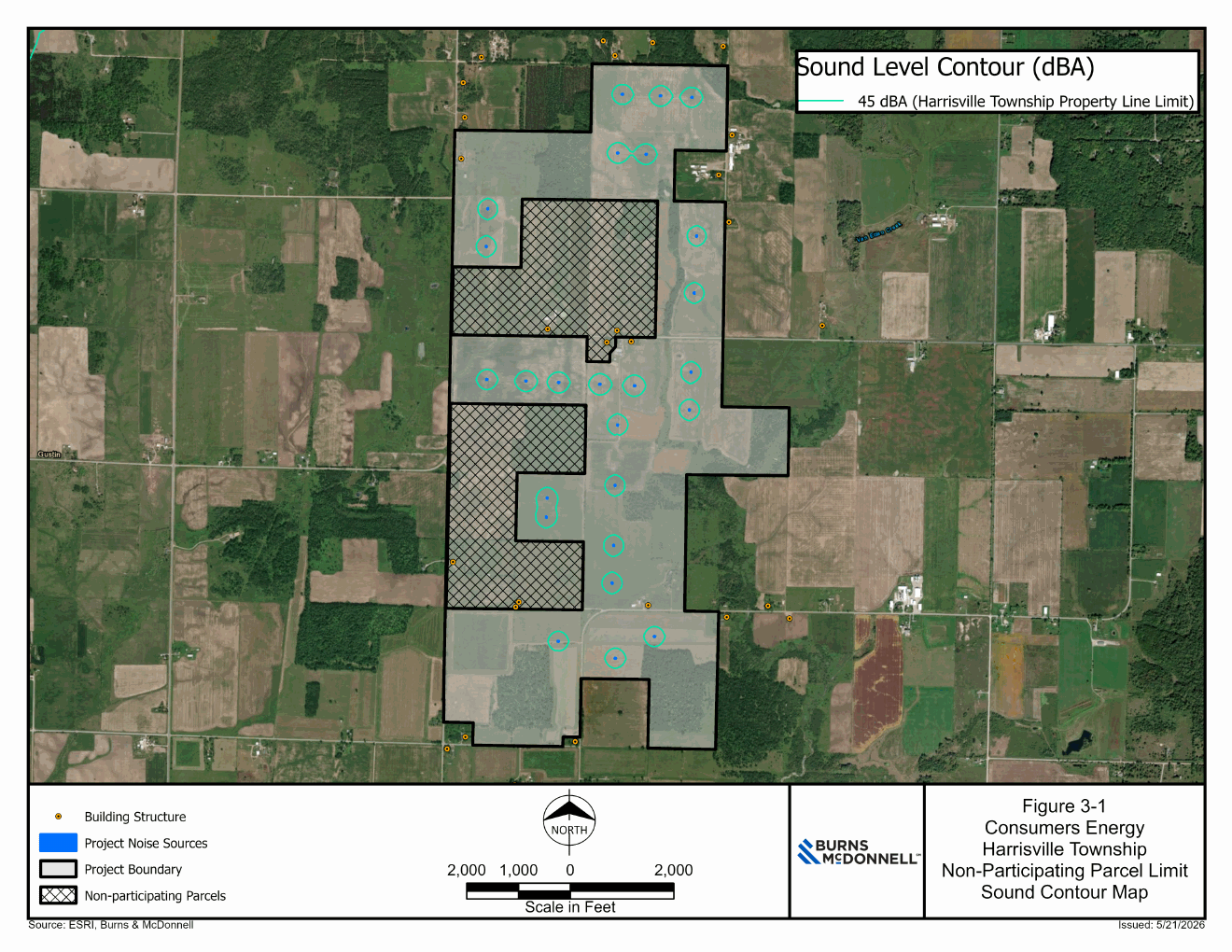
- The 45 dBA contour. The teal line around each station is the 45 dBA contour. The study does not state how far from a station the line falls. (PDF p. 12)
- The legend. The legend lists one contour: “45 dBA (Harrisville Township Property Line Limit)”. (PDF p. 12)
- The sources. Blue dots are the “Project Noise Sources”. Table 3-2 lists 25 sources, each a “Gamesa Electric Proteus PV Station”, at a sound power level of 94 dBA. (PDF p. 11; PDF p. 12)
- The receivers. Orange dots are marked “Building Structure”. The study: measurement points (“receivers”) “were identified at building in the vicinity of the Project”. (PDF p. 11; PDF p. 12)
Receivers: the study says measurement points (“receivers”) “were identified at building in the vicinity of the Project” and maps them in Figure 3-1 (PDF p. 11; PDF p. 12). The study identifies the buildings it modeled as receivers and maps them (Figure 3-1, p. 12); it does not print the modeled level at any of them.
Every sound figure printed in the study (14)
| As printed | What it is | Where |
|---|---|---|
| < 80 dB(A) | Maximum sound pressure level of one Gamesa Electric Proteus PV Station at 1 m distance, on each of the four sides drawn in the vendor's table, “with the power station running at full power and at 50°C ambient temperature” | Vendor noise level declaration (Appendix B), PDF p. 17 |
| < 60 dB(A) | The same, at 10 m distance | Vendor noise level declaration (Appendix B), PDF p. 17 |
| less than 60 dBA at 10 meters | The study's text: the Proteus PV Station “was measured to be less than 60 dBA at 10 meters” | Section 3.2, PDF p. 10 |
| 60 dBA at 10 meters | Sound pressure level used as a model input (printed without “less than”) | Table 3-2, PDF p. 11 |
| 94 dBA | Sound power level used as a model input | Table 3-2, PDF p. 11 |
| 25 | Number of sources (Gamesa Electric Proteus PV Station) | Table 3-2, PDF p. 11 |
| 45 dBA | The one contour in the map's legend: “45 dBA (Harrisville Township Property Line Limit)”. Distance not stated in the study. | Figure 3-1, PDF p. 12 |
| 5 feet above grade | Receptor height. The Grobbel letter: “The use of 5.0 feet noise receptor height is invalid” (letter, p. 3) | Table 3-1, PDF p. 10 |
| 0.5 | Ground absorption | Table 3-1, PDF p. 10 |
| 2 | Number of reflections | Table 3-1, PDF p. 10 |
| 50 °F | Temperature | Table 3-1, PDF p. 10 |
| 70% | Humidity | Table 3-1, PDF p. 10 |
| 45 dBA | The study's summary of the township limit: the ordinance “limits noise to 45 dBA at adjacent non-participating parcels” (the study cites it as “Sec. 7.31 C5”) | Section 2.4, PDF p. 9 |
| 55 average hourly decibels | The study's quotation of the state standard | Section 2.1, PDF p. 9 |
Table 1-1 (PDF p. 8) also lists typical levels of common sound sources; the page’s chart “Sound levels, dBA” shows three of them.
Sources: Preconstruction Sound Study (Burns & McDonnell for Consumers Energy, dated May 27, 2026; filed as Exhibit F, June 15, 2026), PDF pp. 9–12 and 17; Harrisville Twp. Zoning Ordinance Sec. 3.22 C.5; PA 233 of 2023 Sec. 226(8)(a)(iv). The figures are the applicant’s; nothing here is measured or modeled by Inside Michigan.
A six-state study of 1.8 million home sales
A 2023 study by researchers at Lawrence Berkeley National Laboratory and the University of Connecticut analysed “over 1,500 LSPVPs and over 1.8 million home transactions” in California, Connecticut, Massachusetts, Minnesota, North Carolina and New Jersey. (LSPVP is its abbreviation for a large-scale photovoltaic project of at least 1 MW.) It found that “homes within 0.5 mi of a LSPVP experience an average home price reduction of 1.5% compared to homes 2–4 mi away; statistically significant effects are not measurable over 1 mi from a LSPVP” (Elmallah et al., Energy Policy (2023), p. 1). No Michigan sales are in the study.
Township rules beside the state’s
Under PA 233, a developer must apply to the township first where the township has given notice of a compatible ordinance, one no stricter than the state standards. The comparison below sets each township's rules beside those standards, row by row, with the exact text of both. Where they are measured differently, we say so rather than score them.
Township ordinance vs. state standard
What the township requires, beside what the state requires
Why it matters: Under the law, a developer must apply to the township first where the township has given notice of a “compatible renewable energy ordinance,” meaning one no stricter than the state standards in Sec. 226(8) (Sec. 223(3)). Where there is none, the developer may apply to the MPSC or, as Consumers did here, to the township. (From the Gustin Solar briefing, which describes both townships.)
How to read this: each row is one standard PA 233 sets for large solar facilities. “State” and “Township” show each rule’s figure, and the mark beside them says how the two compare. Select a row to read the exact wording of both.
| Requirement | State standard (PA 233) | Harrisville Township ordinance | Comparison |
|---|---|---|---|
| Setback from occupied buildings and dwellings | 300 ft from the perimeter fence to the nearest point on the outer wall; occupied community buildings and dwellings on non-participating propertiesStatute text and citation
| No dwelling setback stated §3.22 C sets distances from property lines and road rights-of-way onlyOrdinance text and citationThe only setback sentence in §3.22 C; it does not mention dwellings.
| Not addressed by the township The ordinance's commercial-solar setback sentence names property lines and road rights-of-way, not dwellings. |
| Setback from public road right-of-way | 50 ft from the perimeter fence to the nearest edge of a public road right-of-wayStatute text and citation
| 50 ft from panels and support structures (perimeter fencing excluded) to any road right-of-way, at minimum tiltOrdinance text and citation
| Not directly comparable Same distance, different starting point: the state measures from the perimeter fence, the township from panels and supports with fencing excluded. |
| Setback from property lines | 50 ft from the perimeter fence to the nearest shared property line; non-participating partiesStatute text and citation
| 40 ft from panels and support structures (perimeter fencing excluded) to a side or rear property line, at minimum tiltOrdinance text and citation
| Township is less strict A shorter distance, measured from equipment inside the fence rather than from the fence. The township text covers every side or rear line, not only lines shared with non-participants. |
| Fencing | National Electric Code latest version as of the act's effective date, or a successor standard approved by the commissionStatute text and citation
| No solar-specific fence standard general fence rule (§3.11): 6 ft maximum height, at least 5 ft from the front property line or road right-of-wayOrdinance text and citationGeneral fence section; §3.22 C mentions perimeter fencing only to exclude it from setbacks.
| Not directly comparable The state points to an electrical code whose text is not among the mirrored records; the township has a general height and placement rule for all fences. |
| Maximum height | 25 ft solar panel components, above ground, with the arrays at full tiltStatute text and citation
| 15 ft the system and any mounts, at maximum tiltOrdinance text and citation
| Township is stricter A lower maximum, measured at the same panel position (full or maximum tilt). |
| Sound limit | 55 dBA maximum, as an hourly average, modeled at the nearest outer wall of the nearest dwelling on an adjacent non-participating propertyStatute text and citation
| 45 dBA one-hour average (Leq), at the property line of an adjacent non-participating lot, at 2 a.m.Ordinance text and citation
| Not directly comparable A lower number at a nearer point (property line, not dwelling wall), but stated for 2 a.m. only; the state figure is a maximum hourly average with no time of day. |
| Lighting | Dark sky-friendly lighting defined as fixtures designed to minimize the light that escapes upward into the skyStatute text and citation
Definition
| No solar-specific lighting rule general outdoor lighting rule (§3.20): down-type fixtures with 100% cut-offOrdinance text and citationGeneral outdoor lighting section; §3.22 has no lighting provision of its own.
| Not directly comparable The state wording is a general description; the township's general lighting section sets a fixture specification. |
| Decommissioning: financial assurance | Not less than the estimated cost, after salvage value bond, parent company guarantee or irrevocable letter of credit (no cash); may be posted in steps: at least 25% by the start of full commercial operation, at least 50% by the start of the fifth year of commercial operation, 100% by the start of the tenth yearStatute text and citation
| No less than 150% of estimated removal cost performance (surety) bond, posted within 15 days after approval or before a construction permit is issuedOrdinance text and citation
| Township is stricter A larger amount with no salvage deduction, one accepted form instead of three, and posted in full at the start rather than in steps. This standard is in §225(1)(r), among the contents of an application for a state certificate (§225(1)); §223(3)(a) applies §225(1) to an application filed with a township that has given notice of a compatible ordinance. It is not in the §226(8) list that the statute's definition of a compatible ordinance points to. |
Also in this ordinance, with no counterpart in the state list (not a complete list): year-round visual screening (§3.22 C.4); groundwater testing (§3.22 C.1(a)); annual sound testing (§3.22 C.5).
Note: The mirrored December 2025 update is labelled "Amendment 2". No document labelled Amendment 1 is among the mirrored records, so its contents could not be checked.
Earlier and later versions of the Harrisville Township rules
- The township's Solar Ordinance (adopted January 16, 2023; mirrored as harrisville-solar-ordinance-2023.pdf) added Section 7.31 to the earlier zoning ordinance. Article Twenty-Four of the May 14, 2025 ordinance repeals "the Zoning Ordinance #11414 previously adopted by the Township and all amendments thereto"; the solar rules now sit at Section 3.22. The figures compared here (40 ft, 50 ft, 15 ft, 45 dBA, 150%) read the same in both texts.
- The December 2025 update (harrisville-zoning-update-2025-12.pdf) is a single page headed "Amendment 2" that revises Section 21.07 (violations, corrections and penalties). It does not touch Section 3.22.
| Requirement | State standard (PA 233) | Caledonia Township ordinance | Comparison |
|---|---|---|---|
| Setback from occupied buildings and dwellings | 300 ft from the perimeter fence to the nearest point on the outer wall; occupied community buildings and dwellings on non-participating propertiesStatute text and citation
| 100 ft for buildings and solar arrays, “adjacent to any residential structure”Ordinance text and citation
| Not directly comparable A shorter distance, but measured from buildings and arrays rather than the fence, and the text does not say whether it runs to the structure or to the lot line. |
| Setback from public road right-of-way | 50 ft from the perimeter fence to the nearest edge of a public road right-of-wayStatute text and citation
| 50 ft from buildings and solar arrays to existing public roads and railroad rights-of-way; fence no more than 50 ft off the right-of-wayOrdinance text and citation
| Not directly comparable Same distance, different starting point: the state measures from the fence, the township from buildings and arrays, and it caps how far the fence may sit from the road. |
| Setback from property lines | 50 ft from the perimeter fence to the nearest shared property line; non-participating partiesStatute text and citation
| 50 ft from buildings and solar arrays to all lot lines of non-participating lots; fence no more than 40 ft from an abutting non-participating lot lineOrdinance text and citation
| Not directly comparable Same distance for arrays, but the state's 50 ft is a minimum measured from the fence, while the township places the fence no more than 40 ft from the line. |
| Fencing | National Electric Code latest version as of the act's effective date, or a successor standard approved by the commissionStatute text and citation
| 7 ft perimeter fence; no electric fencing construction must comply with the National Electric Safety Code and the County Building CodeOrdinance text and citation
| Not directly comparable The state names the National Electric Code; the township sets a fence height and names the National Electric Safety Code. Neither code's text is among the mirrored records. |
| Maximum height | 25 ft solar panel components, above ground, with the arrays at full tiltStatute text and citation
| 15 ft solar arrays and components at maximum tilt, from natural grade; substation and transmission equipment excludedOrdinance text and citation
| Township is stricter A lower maximum, measured at the same panel position (full or maximum tilt). |
| Sound limit | 55 dBA maximum, as an hourly average, modeled at the nearest outer wall of the nearest dwelling on an adjacent non-participating propertyStatute text and citation
| 55 dBA one-hour average (Leq), measured at all non-participating property lines and the existing right-of-way lineOrdinance text and citation
| Not directly comparable Same number, different place: the township measures at property lines and the road right-of-way line, the state at the nearest dwelling's outer wall. |
| Lighting | Dark sky-friendly lighting defined as fixtures designed to minimize the light that escapes upward into the skyStatute text and citation
Definition
| Shielded and directed away from adjacent properties §7.28 L; the general lighting section (§3.19) calls for full cut-off fixturesOrdinance text and citation
General outdoor lighting section.
| Not directly comparable The state wording is about light escaping upward; the township's solar section is about light reaching neighbors and roads. |
| Decommissioning: financial assurance | Not less than the estimated cost, after salvage value bond, parent company guarantee or irrevocable letter of credit (no cash); may be posted in steps: at least 25% by the start of full commercial operation, at least 50% by the start of the fifth year of commercial operation, 100% by the start of the tenth yearStatute text and citation
| Amount set by the township's engineer cash bond or letter of credit; decommissioning security posted before construction starts; reviewed every 5 yearsOrdinance text and citation
| Not directly comparable No percentage is stated. The township accepts a cash bond, which the state excludes, and asks for security before construction, where the state allows steps. This standard is in §225(1)(r), among the contents of an application for a state certificate (§225(1)); §223(3)(a) applies §225(1) to an application filed with a township that has given notice of a compatible ordinance. It is not in the §226(8) list that the statute's definition of a compatible ordinance points to. |
Also in this ordinance, with no counterpart in the state list (not a complete list): 20-acre minimum lot size (§7.28 G); berm and evergreen screening (§7.28 I.1); underground collection lines (§7.28 M).
Note: Caledonia's Planning Commission approved amendments covering solar, wind and battery storage at its August 31, 2026 hearing and sent them to the county; the township board approved Ordinance 26-01 on September 8, 2026 (draft minutes). This comparison still uses the ordinance adopted April 8, 2025, and does not yet reflect the amendments.
A small county carrying a big build
Alcona County had 10,556 residents on July 1, 2025, 75th of Michigan's 83 counties, and its median age, 59.0, was the second highest in the state (Census Bureau estimates, Vintage 2025: population; age). Consumers Energy's website lists two solar projects in the county: Gustin (335 megawatts) and Caledonia (117 megawatts) (company project page, viewed Oct 2, 2026). No Caledonia application is in our records; the township Planning Commission's minutes of Aug 31, 2026 say “nothing has been submitted in Caledonia Township at this time” (draft minutes, p. 4).
What the record shows on benefits and costs
Benefits claimed in the record
- Lifetime tax revenue claimed for Sapling Solar, the 215 MW predecessor (Ranger Power, Oct 2024)“over $12 million” (handout, p. 1)
- Harrisville Twp. parcels under easementten parcels, “totaling 1,015 acres (+/-)” (letter, p. 4; Exhibit A)
- Construction jobs claimed for Sapling Solar“hundreds of jobs during construction” (same handout)
- Operating term and afterwards (Consumers)up to 30 years; “the land restored to a condition that supports the resumption of agriculture in the future” (SUP summary, PDF pp. 4, 16)
Costs and concerns in the record
- Fenced area, both townships~1,800 ac (Consumers, Gustin PC minutes, June 2, 2026)
- Home prices within 0.5 mi of large solar projects, six-state study (Panel 06)−1.5% average; −3% near projects on previously agricultural land
- State certificate route for solar of 50 MW or morePA 233 (Sec. 222(1)(a); see Panel 03)
Harrisville Township Board minutes record public comment on the project: “Two members of the township expressed concerns and questions about the solar panels in the township” (Apr 14, 2026); “A representative from Consumers Energy attended the meeting to answer questions regarding solar panels” (May 12, 2026); “Multiple residents expressed consurens [sic] and questions about the solar farms” (June 9, 2026).
What we could not verify
A briefing you can trust tells you where its floor is soft. These claims — from the letter, the utility, and this research — remain open.
- □The Harrisville filing's figures are in the mirrored application: 94 MWac in Consumers' application summary (SUP summary, PDF p. 5) and decommissioning plan (Exhibit G, p. 5); 165,321 solar modules in the summary (PDF p. 6) and the decommissioning plan (Exhibit G, p. 7); 523 acres of fenced site in the decommissioning plan (Exhibit G, p. 7), where the site plan gives 479.7 acres (Exhibit B, p. 1).
- □Whether Harrisville Township has a master plan. The Grobbel letter says, “Based on information and belief,” that the township zones without one (letter, p. 3). The township's zoning page, as captured Oct 1, 2026, lists no master plan, and the searchable text of its May 14, 2025 zoning ordinance does not mention one (zoning page; ordinance). No record we hold shows whether the township has adopted one.
- □Consumers' own numbers disagree: its filings give 240 and 241 MWac for the Gustin side and 479.7 and 523 fenced acres for the Harrisville side; an in-service date of June 2027 (Harrisville cover letter) and of December 31, 2028 (Harrisville application summary); Consumers Energy's announcement quotes its president of electric supply, Sri Maddipati: “We’re grateful for the positive reception we’ve received from property owners and elected leaders in these communities” (news release, Sept 26, 2025).
- □The letter's hydrology framing is loose: Van Etten Lake sits downstream in the next county (Iosco), reached via Van Etten Creek and the Pine River system — a real drainage connection, but not the on-site waterbody a reader might picture.
- □Whether wetland delineation was submitted — the letter's core "incompleteness" charge — rests on the letter's own "information and belief," not a confirmed file review.
- □Modeled sound levels at nearby buildings. The study identifies the buildings it modeled as receivers and maps them (Figure 3-1, p. 12); it does not print the modeled level at any of them (Exhibit F, PDF pp. 11–12).
Shape it hard, while you still can
Given everything above — a real project, a partly-right letter, and a state law that caps local power — the community's strongest position isn't a bet-the-farm veto. It's maximum leverage applied early, in the venue that still exists.
TBFor the Township Board
- Settle the master plan question now. If no plan exists, start one — it strengthens every future decision regardless of how this project ends.
- Get a PA 233 legal opinion before voting. Know exactly which ordinance provisions survive compatibility review — don't discover it from a preemption filing.
- Demand the checkable fixes: a glare re-run bounded at maximum panel tilt with second-story receptors; the wetland delineation on file; a traffic study. These fit within state limits.
- Negotiate a host community agreement while the file is local. Townships that litigate and lose get the state defaults — and nothing else.
RFor Residents — every side
- Show up: Planning Commission, first Wednesday of even-numbered months, 7 p.m. That room is where conditions get written.
- Ask precise questions. "What panel height did the glare model use?" moves a board. Imported statistics about distant harms mostly don't.
- Read the actual file — the application and exhibits are on the township website. Both the letter and the utility are advocating; the documents are the ground truth.
- Know what "no" buys. If denial routes the project to Lansing, the community loses its conditions along with the fight. Weigh that trade explicitly.
CEFor Consumers Energy
- Re-run the glare and sound models voluntarily with conservative bounds. It's cheap, and the current assumptions are the letter's best ammunition.
- Put the wetland delineation and interconnection evidence on the table before being asked twice.
- Offer a host community agreement. You have a second project (Caledonia) and a nine-project pipeline that all need northern Michigan's goodwill. A preemption victory that poisons the county is a bad trade.
The honest answer: this is no longer a purely local decision. The letter is right that the application deserves harder scrutiny — and wrong to imply the township can simply refuse its way out. The community's best route is to use the local process it still controls to extract a better, better-documented project: corrected studies, ironclad decommissioning, real host benefits. Fight for the terms, not just the verdict.
Sources
Compiled August 6, 2026; updated October 2, 2026. Every primary record below is mirrored, unaltered and fingerprinted, in the records library.
Primary records behind the October 1 update (18)
Gustin Twp. Planning Commission minutes, Aug 6, 2026
Gustin Twp. Planning Commission minutes, July 13, 2026
Gustin Twp. Planning Commission minutes, June 2, 2026
Gustin Twp. minutes, Dec 2, 2024 (Sapling Solar)
Consumers Energy, application to Gustin Township, May 15, 2026
Harrisville application, Exhibit B site plan
Harrisville application, Exhibit G decommissioning plan
Grobbel Environmental & Planning Associates, comment letter, July 26, 2026
Harrisville Township Zoning Ordinance, May 2025
Harrisville Township zoning page, captured Oct 1, 2026
Michigan Court of Appeals opinion, May 7, 2026 (No. 373259)
Michigan Supreme Court docket, No. 170249, captured Oct 1, 2026
Michigan Supreme Court order, Sept 9, 2026
MPSC current siting applications, captured Oct 1, 2026
MCL 125.3203 (Zoning Enabling Act), captured Oct 1, 2026
MCL 324.1705 (Part 17, Environmental Protection Act), captured Oct 1, 2026
Records added for the October 2 update (6)
Consumers Energy, news release, Sept 26, 2025, captured Oct 2, 2026
Consumers Energy, solar projects page, Northern Michigan tab, captured Oct 2, 2026
Consumers Energy, solar projects page, all tabs (page source), captured Oct 2, 2026
Census Bureau, county population estimates, Vintage 2025
Census Bureau, Michigan county estimates by age and sex, Vintage 2025
Census Bureau, American Community Survey 2020–2024 5-year, table B19013
Sources consulted for the August 6 briefing (26)
Michigan Legislature — Public Act 233 of 2023, full text (legislature.mi.gov)
Michigan Public Service Commission — Renewable energy facility siting pages & Act 233 filing requirements (michigan.gov/mpsc)
Michigan Townships Association — Renewable energy siting & permitting guidance
Columbia Law School, Climate Law Blog — Court of Appeals ruling on MPSC siting process (July 2026)
Foster Swift — announcement of the appeal to the Michigan Supreme Court (Supreme Court No. 170249; Court of Appeals No. 373259)
Bridge Michigan — PA 233 lawsuit & implementation coverage (2 articles)
WCMU Public Media — "Some green energy projects struggle in Michigan…" (June 2026)
Interlochen Public Radio / Michigan Advance — PA 233 and local control in northern Michigan
Consumers Energy — Gustin Solar announcement (Sept 26, 2025); solar projects page; Clean Energy Plan materials
The Alpena News — Gustin Solar announcement coverage (Sept 2025)
Rigzone — Gustin Solar project report (Oct 2025)
True North Radio Network — Alcona County solar coverage
Harrisville Township — Zoning page: SLU application exhibits, ordinance documents, meeting schedule (harrisvilletownship.com)
Gustin Township / Alcona Conservatives — Sapling Solar application narrative & benefits sheet (Oct 2024)
WMUK / WWMT — Liberty Farms Solar hearings, Kalamazoo County (May 2026)
Lawrence Berkeley National Laboratory — "Shedding Light on Large-Scale Solar Impacts," Energy Policy (2023)
Canary Media / Inside Climate News / Michigan Public — LBNL study coverage
Sandia National Laboratories — Solar Glare Hazard Analysis Tool documentation
ForgeSolar — Glare modeling help guide (height-bounding practice)
Kane County, IL — Solar glare study, Appendix M (receptor-height practice)
Penn State Extension — "Solar Panel Glare: Is It an Issue?"
Acentech — Solar farm noise measurements
Michigan EGLE — Part 303 wetland permit requirements
ScienceDirect — 7-year soil study under ground-mounted PV (Central Italy)
American Farmland Trust — Smart Solar / agrivoltaics program
U.S. Census Bureau / Data USA — Alcona County demographics